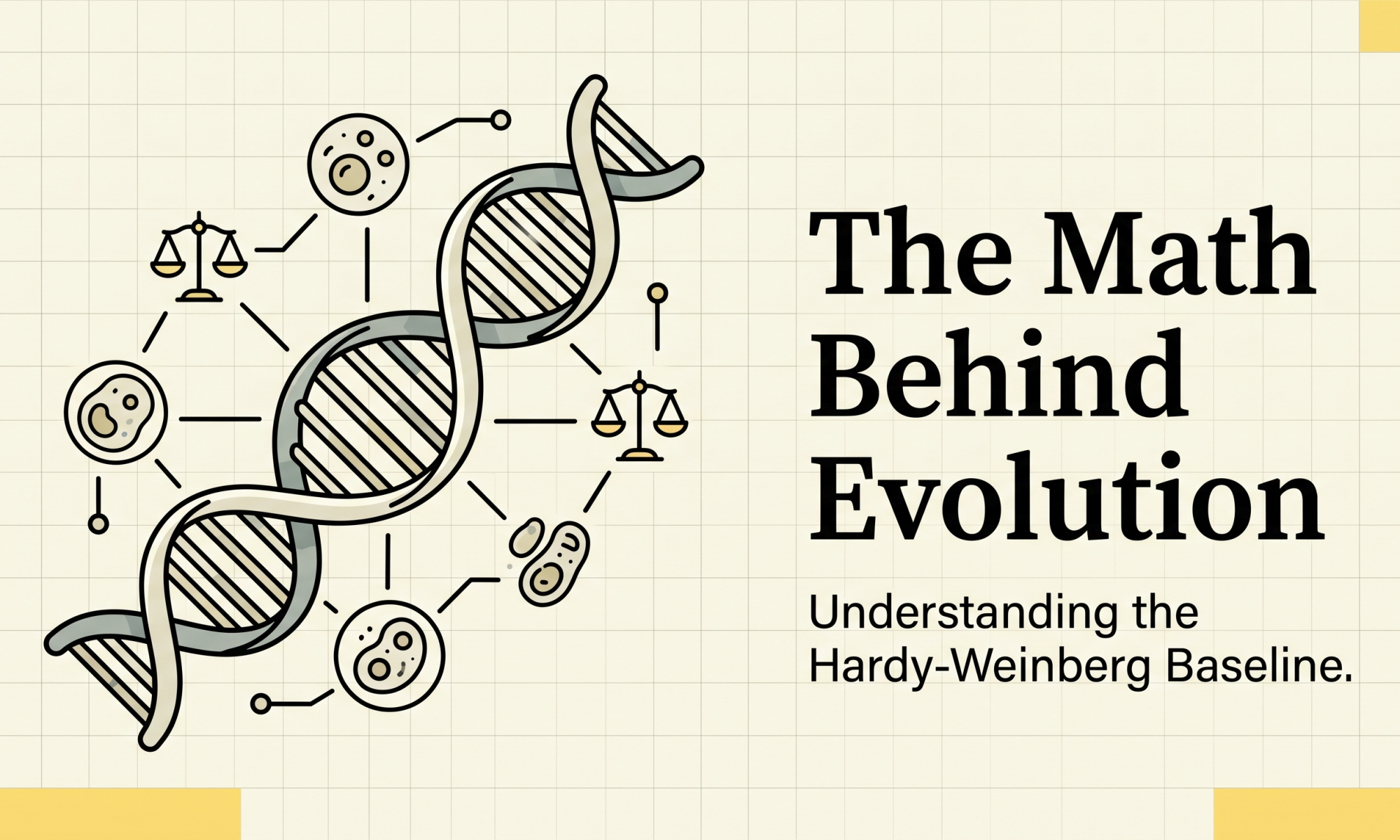
Is Evolution Always Happening? The Hardy-Weinberg Paradox Explained

Is Evolution Always Happening? The Hardy-Weinberg Paradox Explained
Demystifying Hardy-Weinberg Equilibrium: The Impossible Baseline of Evolution

Demystifying Hardy-Weinberg Equilibrium: The Impossible Baseline of Evolution

Published on June 15, 2026

We spend so much time studying how organisms change that we rarely ask the inverse question: What actually happens when a population stops evolving?

This is the core premise of the Hardy-Weinberg Equilibrium—a theoretical state of absolute biological perfection where gene frequencies are completely locked in place from one generation to the next. While it sounds ideal, this state practically never exists in nature. Let’s break down why this impossible baseline matters and how the underlying math works.


1. The Myth of Equilibrium: An Impossible Baseline

Think of population genetics like tracking a car trip. You cannot accurately measure how far a car has traveled unless you know precisely where the starting line was. The Hardy-Weinberg Equilibrium functions as biology’s universal starting line.

To sit perfectly on this starting line, a population must strictly adhere to five massive rules:

  • No gene mutations can occur.
  • Zero migration (no individuals moving in or out).
  • Mating must be entirely random.
  • No genetic drift (changes due to pure chance).
  • No natural selection acting on traits.

Because nature is inherently messy, at least one of these rules is always broken. Therefore, true equilibrium is a myth—but a highly useful one.

2. The Genetic Math Toolkit

To translate these biological concepts into quantifiable metrics, scientists rely on two core variables:

p = the frequency of the dominant allele

q = the frequency of the recessive allele

Because we are measuring an entire population pool, the individual alleles must always total 100%. This gives us our foundational equation:

p + q = 1

When measuring whole individuals instead of single floating alleles, we square the relationship to determine paired genotypes:

p² + 2pq + q² = 1

  • represents homozygous dominant individuals.
  • 2pq represents heterozygous (mixed) individuals.
  • represents homozygous recessive individuals.

3. Cat Genetics Step-by-Step

Let’s take a hypothetical population of 1,000 cats to see this toolkit in action. In Generation 1, we observe 840 black cats and 160 white cats. Because black is a dominant trait, those cats could be pure dominant (p²) or mixed (2pq). White is a recessive trait, meaning its genetic code is definitively known (q²).

Rule of thumb: Always start your math with the recessive trait.

  1. Find q²: 160 white cats / 1,000 total cats = 0.16
  2. Find q: Take the square root of 0.16, which equals 0.4.
  3. Solve for p: Using our p + q = 1 equation, we subtract 0.4 from 1 to find that p = 0.6.

By plugging p and q back into our expansion equation, we can map out the entire structural makeup of our feline generation: 360 homozygous dominant black cats, 480 heterozygous black cats, and 160 white cats.

4. Did the Population Evolve?

Imagine Generation 2 drops to 800 cats due to environmental pressures, counting 672 black cats and 128 white cats. Do these shifting raw numbers mean evolution took place?

Let’s look at the math for our recessive indicators again: 128 / 800 equals a q² of 0.16. Taking the square root gives us a q value of 0.4. Because our underlying allele frequencies (p and q) stayed identical across generations despite the shifting raw population size, this specific gene pool is genetically frozen in time. No evolution has occurred.

5. Why the Baseline Matters

If real-world populations match our baseline equations perfectly, it proves zero change is happening. However, if our Generation 2 calculation had yielded a q value of 0.5 instead of 0.4, we would have undeniable mathematical proof of evolution.

Discrepancies from the equilibrium notify scientists that a rule has been shattered—signaling that forces like geographic migration, structural mutations, or selective environmental pressures are actively reshaping a species’ survival trajectory.
Mathematical context inspired by insights from the Academic Center for Excellence.

From Newton to Relativity: How Einstein Rewrote the Laws of Physics

From Newton to Relativity: How Einstein Rewrote the Laws of Physics

If you think you completely understand how objects move based on your high school science classes, prepare to have your perspective shifted. When transitioning to first-year university physics, we have to explore the absolute limits of Newton’s laws of motion and uncover fundamental paradoxes that force us to rethink the very nature of reality, space, and gravity. Welcome to the journey from classical clockwork mechanics to the revolutionary universe of Albert Einstein.

The Law of Inertia and Its Hidden Catch

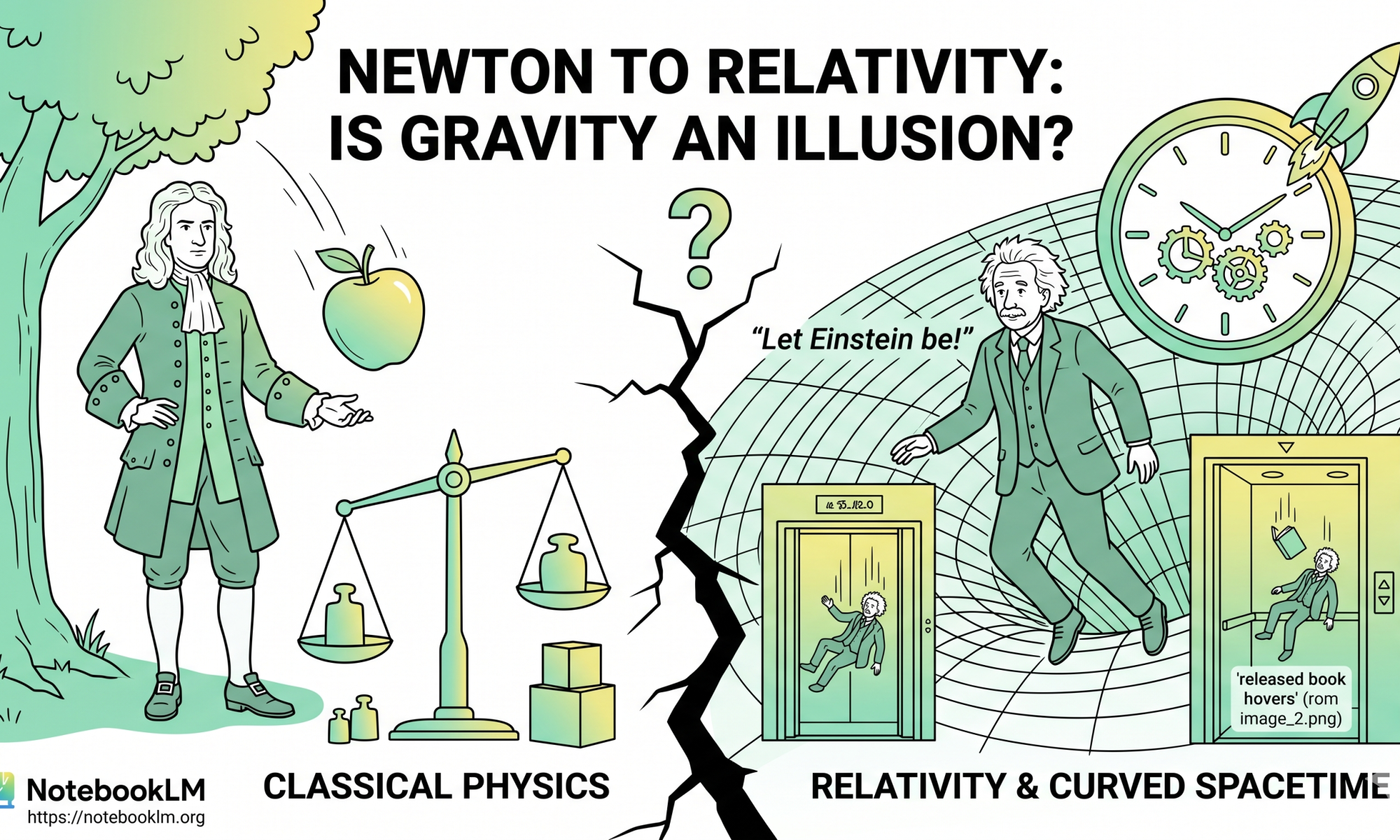
You likely know the drill with Newton’s first law: an object at rest stays at rest unless a net force acts upon it. It seems incredibly simple and universally true. However, there is a crucial caveat that is often glossed over. The absolute nature of Newton’s law of inertia is only true from a very specific point of view known as an inertial reference frame.

If your frame of reference is accelerating or rotating, this familiar law suddenly breaks down. Objects begin to behave as if they are possessed, moving without any physical push or pull.

Noninertial Frames and Fictitious Forces

Imagine sitting on a perfectly frictionless, spinning merry-go-round. You gently place a tennis ball on the floor next to you. Without you exerting any net force, the ball suddenly accelerates and flies outward toward the edge. According to Newton’s first law, this should be impossible. Yet, from your rotating perspective, the ball moves. Newton’s first law has effectively just failed.

To save the mathematical equations in these rotating, noninertial frames, physicists had to invent clever mathematical tricks called fictitious forces. When that ball flies outward, we can still use force equals mass times acceleration, but only if we pretend an invisible force, like centrifugal force or the Coriolis effect, is pushing it. It is vital to understand that there is no actual object exerting this pull. It is a necessary mathematical illusion created entirely by the rotation of your reference frame.

Einstein’s Equivalence Principle

This brings us to one of the most profound thought experiments in relativity. Imagine you are in a completely closed elevator floating in deep space. The elevator begins accelerating uniformly upward. You feel a force pushing you backward, pinning you against the floor. Now, ask yourself: how do you actually know you are accelerating?

What if that elevator is just sitting at rest on the surface of the Earth, and what you feel is simply the downward pull of gravity? Albert Einstein realized something incredible here: universal acceleration and a uniform gravitational field are physically indistinguishable. No experiment inside that closed box could ever tell the difference. They are absolutely equivalent.

Two Types of Mass: Inertial and Gravitational

In physics, there are two distinct ways to define mass. Inertial mass represents an object’s stubborn resistance to being accelerated by a push or a pull. Gravitational mass dictates how strongly one object attracts another, acting almost like a gravitational charge.

These are drastically different concepts. One is about resisting a push, while the other is about pulling things together. Yet, remarkably, no experiment has ever found a measurable difference between them. The Equivalence Principle boldly states that gravitational mass is exactly equivalent to inertial mass. They are fundamentally the exact same thing.

The Ultimate Conclusion: Is Gravity an Illusion?

This exact equivalence is the profound reason why all objects, no matter how heavy or light, fall at the exact same acceleration in a vacuum. It is not a lucky cosmic coincidence. This foundation allowed Einstein to propose that gravity is not a traditional force at all.

If gravity is just objects following the natural curvature of spacetime, and if acceleration perfectly mimics gravitational fields, are the forces we feel every day simply an illusion of our reference frame? Just like the fictitious forces on the spinning merry-go-round, gravity might just be a consequence of us not realizing we are actually in a noninertial frame. This complete redefinition of reality is exactly what you need to master in university physics.

If you are looking to conquer these mind-bending concepts, the expert tutors at Vancouver Top Tutors are here to help you succeed in your educational journey. Reach out today to master the universe, from Newton to relativity.

Unseen Chemistry: A Guide to the Intermolecular Forces Holding Our World Together

Intermolecular forces and bonds explained

Ever wondered how insects walk on water, or how the massive strands of your DNA stay perfectly locked in that iconic double helix?

The answer lies in the microscopic world of intermolecular forces! In this video, we break down the invisible connections that govern the physical world around us—from the fleeting attraction of London dispersion forces and the permanent magnetism of dipole-dipole interactions to the ultimate biological superpower of hydrogen bonds. Discover how these delicate molecular interactions create the solids and liquids we take for granted every day, and find out the terrifying reality of what would happen if they suddenly vanished.

Unseen Chemistry: A Guide to the Intermolecular Forces Holding Our World Together

We often take the properties of the liquids and solids around us for granted. However, literally everything—from the water you drink to the very DNA that defines you—is governed by unseen, microscopic interactions occurring constantly right under our noses. Understanding these intermolecular forces is essential for mastering foundational chemistry.

The Critical Shift: Intermolecular vs. Intramolecular Forces

Right off the bat, the absolute most important distinction we need to make is the difference between intermolecular and intramolecular forces.

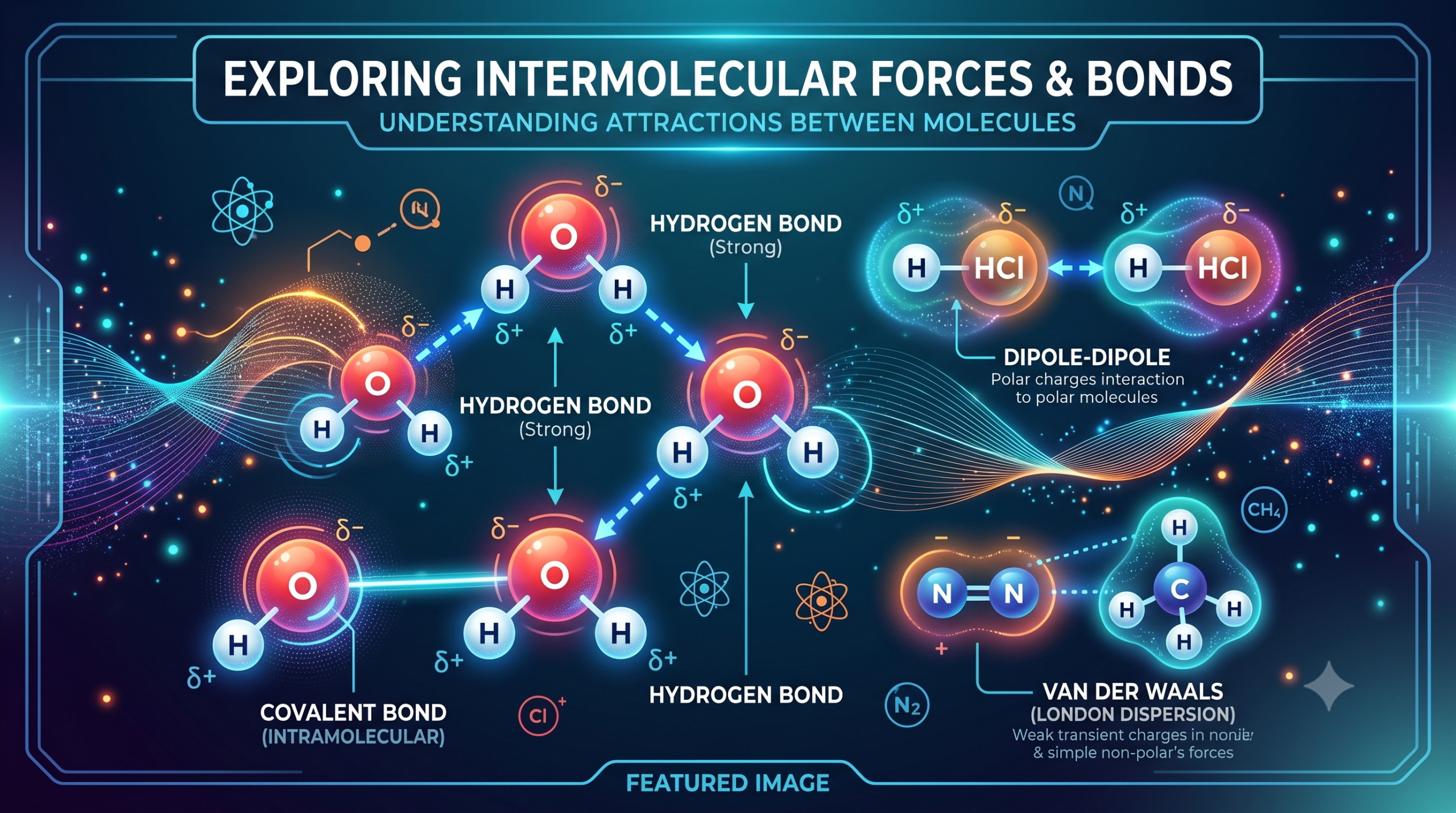
Intramolecular forces are the strong chemical bonds holding a single molecule together, such as the tight covalent bonds between hydrogen and oxygen inside one water molecule. Intermolecular forces, on the other hand, are the attractive forces that exist between completely separate molecules. These forces are responsible for individual molecules clumping together to form condensed phases like liquids and solids.

Many of these interactions fall under the big umbrella term van der Waals forces, named after the Dutch physicist Johannes Diderik van der Waals. This family of forces includes dispersion forces, dipole-induced dipole forces, and dipole-dipole forces.

Dispersion Forces: The Fleeting Attraction

How does a completely nonpolar, neutral substance like helium condense into a liquid at low temperatures? By normal logic, neutral atoms shouldn’t attract each other at all. The answer lies in the constant movement of electrons.

If you average an atom’s electron distribution over time, it appears perfectly uniform. But at any single, tiny fraction of a second, those electrons can accidentally cluster on one side of the nucleus. This creates a temporary, instantaneous dipole. This fleeting miniature magnet induces a temporary dipole in its neighboring atom, creating a short-lived but very real attraction known as a London dispersion force (named after physicist Fritz London).

The strength of dispersion forces scales with the size of the electron cloud. Larger molecules with more electrons are more “squishy” or highly polarizable, leading to stronger temporary attractions and higher melting or boiling points.

Dipole-Dipole Interactions: Permanent Molecular Magnets

Unlike the temporary dipoles found in nonpolar substances, some molecules are built with a permanent imbalance of charge due to differences in electronegativity. We call these polar molecules.

Dipole-dipole forces are the electrostatic attractions between these permanent molecular magnets. Governed by Coulomb’s law, these molecules physically rotate and align themselves in space so that the partially positive end of one molecule continuously seeks out the partially negative end of another, establishing a permanent, built-in attraction.

Hydrogen Bonds: Life’s Superpower

The most famous and biologically significant intermolecular force is the hydrogen bond. However, you can’t just throw hydrogen into any molecule and get a hydrogen bond; it has a very strict, exclusive set of requirements:

  • A hydrogen atom must be directly, covalently bonded to a highly electronegative atom.
  • That electronegative atom must specifically be Oxygen (O), Nitrogen (N), or Fluorine (F).
  • The O, N, or F atom must possess at least one lone, unshared pair of electrons to act as a landing pad for a neighboring hydrogen.

When these criteria are met, the highly electronegative atom hogs the electron density, leaving the hydrogen atom as an intensely positive, bare proton. This proton is then powerfully attracted to the electron-rich lone pairs of neighboring molecules.

Putting Forces in Perspective

While hydrogen bonds are incredibly influential, we need to keep their actual strength in perspective compared to true chemical bonds:

Bond Type Approximate Energy Required to Break
Standard Covalent Single Bond (Intramolecular) ~400 kJ/mol
Hydrogen Bond (Intermolecular) ~200 kJ/mol

Though it is only a fraction of the strength of a true chemical bond, this relatively weak force completely rewrites the rules of biology. For instance, the massive double helix of your DNA is held together down the middle by millions of these hydrogen bonds. They act like the rungs on a twisted ladder—strong enough to keep your genetic code perfectly stable inside your cells, yet weak enough for enzymes to easily unzip them when it is time to replicate or read the code.

What Happens If They Vanish?

The physical structure of our world relies entirely on these delicate, invisible attractions. If the magic of the hydrogen bond were to suddenly vanish from the universe, the oceans would instantly boil away into vapor, our DNA would completely unravel, and cellular proteins would lose their shapes entirely. Every melting point, boiling point, and surface tension quirk you encounter is simply a macro-level measurement of these tiny molecular interactions holding the world together.

If you or your student are working to conquer the complexities of molecular geometry and chemical bonding, the expert team at Vancouver Top Tutors is here to guide you. Reach out today to connect with a specialized chemistry tutor and achieve your academic goals!

#intermolecularforces #ChemistryExplained #ScienceShorts #STEM #LearnOnTikTok #Biochemistry #HowItWorks #MolecularBonds #ScienceFacts #Physics NewtonToRelativity #PhysicsTutor #VancouverTopTutors #EquivalencePrinciple #AlbertEinstein #IsaacNewton #UniversityPhysics #PhysicsEducation #ScienceBlog