
Ever wondered how insects walk on water, or how the massive strands of your DNA stay perfectly locked in that iconic double helix?
The answer lies in the microscopic world of intermolecular forces! In this video, we break down the invisible connections that govern the physical world around us—from the fleeting attraction of London dispersion forces and the permanent magnetism of dipole-dipole interactions to the ultimate biological superpower of hydrogen bonds. Discover how these delicate molecular interactions create the solids and liquids we take for granted every day, and find out the terrifying reality of what would happen if they suddenly vanished.
Unseen Chemistry: A Guide to the Intermolecular Forces Holding Our World Together
We often take the properties of the liquids and solids around us for granted. However, literally everything—from the water you drink to the very DNA that defines you—is governed by unseen, microscopic interactions occurring constantly right under our noses. Understanding these intermolecular forces is essential for mastering foundational chemistry.
The Critical Shift: Intermolecular vs. Intramolecular Forces
Right off the bat, the absolute most important distinction we need to make is the difference between intermolecular and intramolecular forces.
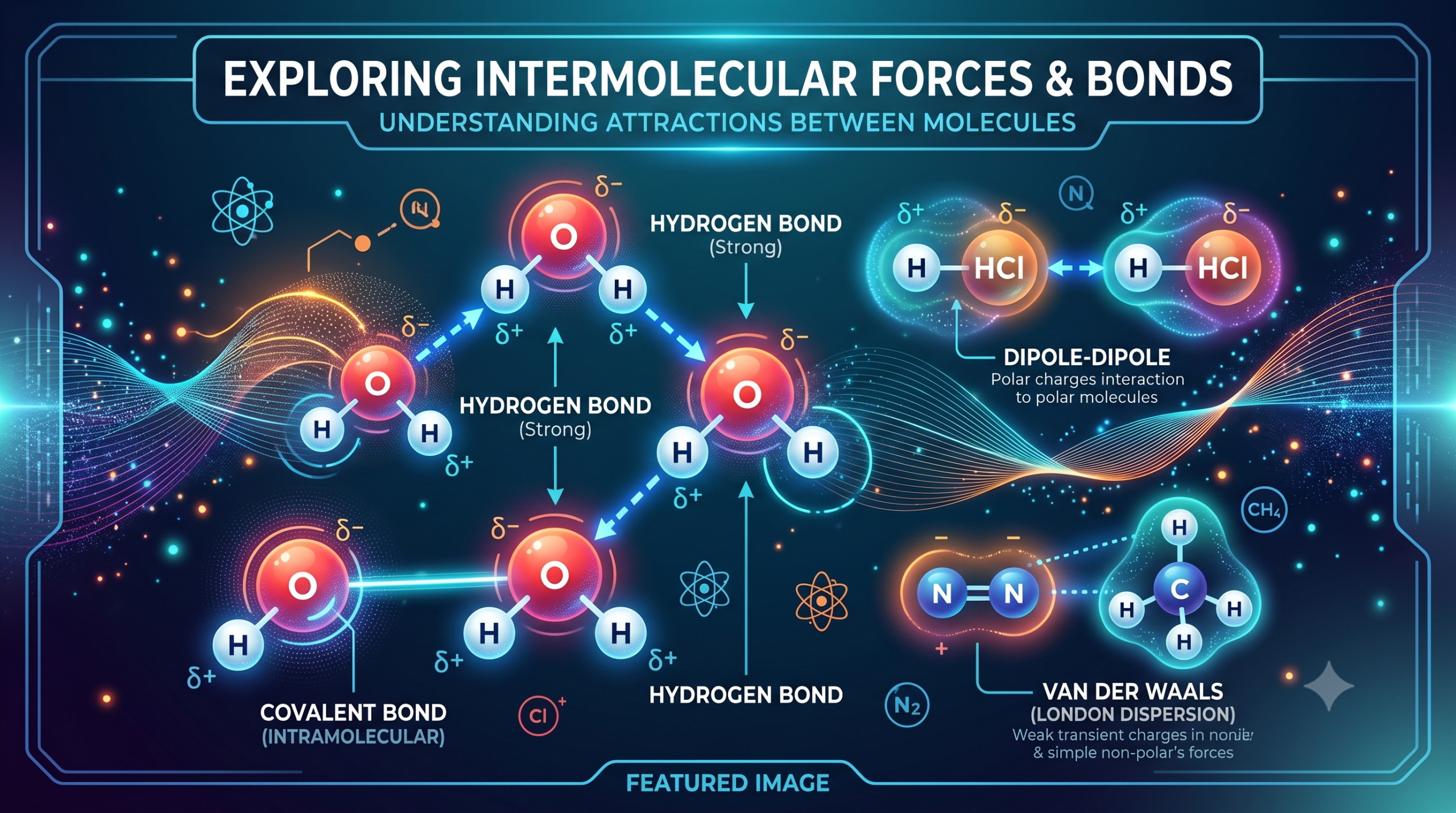
Intramolecular forces are the strong chemical bonds holding a single molecule together, such as the tight covalent bonds between hydrogen and oxygen inside one water molecule. Intermolecular forces, on the other hand, are the attractive forces that exist between completely separate molecules. These forces are responsible for individual molecules clumping together to form condensed phases like liquids and solids.
Many of these interactions fall under the big umbrella term van der Waals forces, named after the Dutch physicist Johannes Diderik van der Waals. This family of forces includes dispersion forces, dipole-induced dipole forces, and dipole-dipole forces.
Dispersion Forces: The Fleeting Attraction
How does a completely nonpolar, neutral substance like helium condense into a liquid at low temperatures? By normal logic, neutral atoms shouldn’t attract each other at all. The answer lies in the constant movement of electrons.
If you average an atom’s electron distribution over time, it appears perfectly uniform. But at any single, tiny fraction of a second, those electrons can accidentally cluster on one side of the nucleus. This creates a temporary, instantaneous dipole. This fleeting miniature magnet induces a temporary dipole in its neighboring atom, creating a short-lived but very real attraction known as a London dispersion force (named after physicist Fritz London).
The strength of dispersion forces scales with the size of the electron cloud. Larger molecules with more electrons are more “squishy” or highly polarizable, leading to stronger temporary attractions and higher melting or boiling points.
Dipole-Dipole Interactions: Permanent Molecular Magnets
Unlike the temporary dipoles found in nonpolar substances, some molecules are built with a permanent imbalance of charge due to differences in electronegativity. We call these polar molecules.
Dipole-dipole forces are the electrostatic attractions between these permanent molecular magnets. Governed by Coulomb’s law, these molecules physically rotate and align themselves in space so that the partially positive end of one molecule continuously seeks out the partially negative end of another, establishing a permanent, built-in attraction.
Hydrogen Bonds: Life’s Superpower
The most famous and biologically significant intermolecular force is the hydrogen bond. However, you can’t just throw hydrogen into any molecule and get a hydrogen bond; it has a very strict, exclusive set of requirements:
- A hydrogen atom must be directly, covalently bonded to a highly electronegative atom.
- That electronegative atom must specifically be Oxygen (O), Nitrogen (N), or Fluorine (F).
- The O, N, or F atom must possess at least one lone, unshared pair of electrons to act as a landing pad for a neighboring hydrogen.
When these criteria are met, the highly electronegative atom hogs the electron density, leaving the hydrogen atom as an intensely positive, bare proton. This proton is then powerfully attracted to the electron-rich lone pairs of neighboring molecules.
Putting Forces in Perspective
While hydrogen bonds are incredibly influential, we need to keep their actual strength in perspective compared to true chemical bonds:
| Bond Type | Approximate Energy Required to Break |
|---|---|
| Standard Covalent Single Bond (Intramolecular) | ~400 kJ/mol |
| Hydrogen Bond (Intermolecular) | ~200 kJ/mol |
Though it is only a fraction of the strength of a true chemical bond, this relatively weak force completely rewrites the rules of biology. For instance, the massive double helix of your DNA is held together down the middle by millions of these hydrogen bonds. They act like the rungs on a twisted ladder—strong enough to keep your genetic code perfectly stable inside your cells, yet weak enough for enzymes to easily unzip them when it is time to replicate or read the code.
What Happens If They Vanish?
The physical structure of our world relies entirely on these delicate, invisible attractions. If the magic of the hydrogen bond were to suddenly vanish from the universe, the oceans would instantly boil away into vapor, our DNA would completely unravel, and cellular proteins would lose their shapes entirely. Every melting point, boiling point, and surface tension quirk you encounter is simply a macro-level measurement of these tiny molecular interactions holding the world together.
If you or your student are working to conquer the complexities of molecular geometry and chemical bonding, the expert team at Vancouver Top Tutors is here to guide you. Reach out today to connect with a specialized chemistry tutor and achieve your academic goals!
#intermolecularforces #ChemistryExplained #ScienceShorts #STEM #LearnOnTikTok #Biochemistry #HowItWorks #MolecularBonds #ScienceFacts #Physics NewtonToRelativity #PhysicsTutor #VancouverTopTutors #EquivalencePrinciple #AlbertEinstein #IsaacNewton #UniversityPhysics #PhysicsEducation #ScienceBlog