
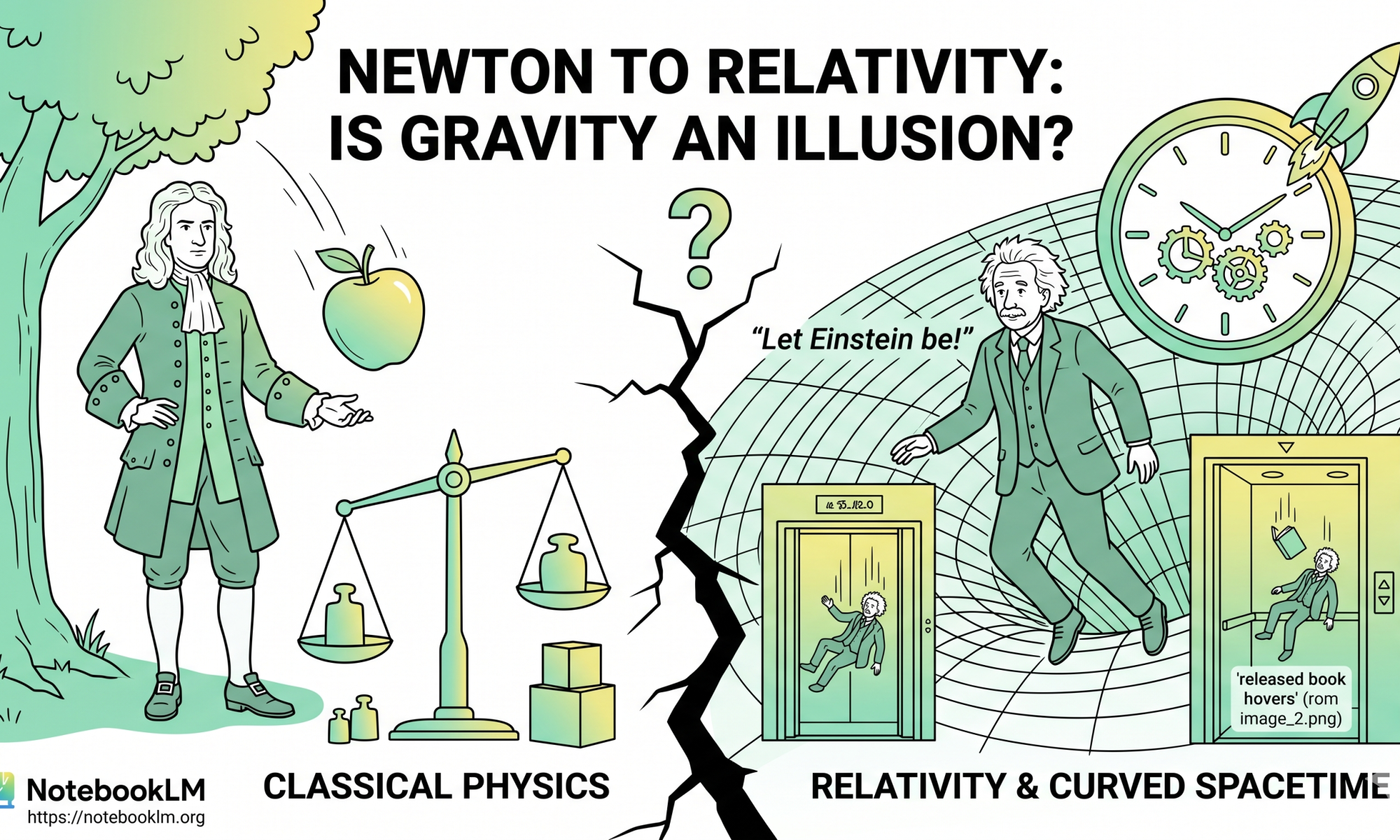
From Newton to Relativity: How Einstein Rewrote the Laws of Physics
If you think you completely understand how objects move based on your high school science classes, prepare to have your perspective shifted. When transitioning to first-year university physics, we have to explore the absolute limits of Newton’s laws of motion and uncover fundamental paradoxes that force us to rethink the very nature of reality, space, and gravity. Welcome to the journey from classical clockwork mechanics to the revolutionary universe of Albert Einstein.
The Law of Inertia and Its Hidden Catch
You likely know the drill with Newton’s first law: an object at rest stays at rest unless a net force acts upon it. It seems incredibly simple and universally true. However, there is a crucial caveat that is often glossed over. The absolute nature of Newton’s law of inertia is only true from a very specific point of view known as an inertial reference frame.
If your frame of reference is accelerating or rotating, this familiar law suddenly breaks down. Objects begin to behave as if they are possessed, moving without any physical push or pull.
Noninertial Frames and Fictitious Forces
Imagine sitting on a perfectly frictionless, spinning merry-go-round. You gently place a tennis ball on the floor next to you. Without you exerting any net force, the ball suddenly accelerates and flies outward toward the edge. According to Newton’s first law, this should be impossible. Yet, from your rotating perspective, the ball moves. Newton’s first law has effectively just failed.
To save the mathematical equations in these rotating, noninertial frames, physicists had to invent clever mathematical tricks called fictitious forces. When that ball flies outward, we can still use force equals mass times acceleration, but only if we pretend an invisible force, like centrifugal force or the Coriolis effect, is pushing it. It is vital to understand that there is no actual object exerting this pull. It is a necessary mathematical illusion created entirely by the rotation of your reference frame.
Einstein’s Equivalence Principle
This brings us to one of the most profound thought experiments in relativity. Imagine you are in a completely closed elevator floating in deep space. The elevator begins accelerating uniformly upward. You feel a force pushing you backward, pinning you against the floor. Now, ask yourself: how do you actually know you are accelerating?
What if that elevator is just sitting at rest on the surface of the Earth, and what you feel is simply the downward pull of gravity? Albert Einstein realized something incredible here: universal acceleration and a uniform gravitational field are physically indistinguishable. No experiment inside that closed box could ever tell the difference. They are absolutely equivalent.
Two Types of Mass: Inertial and Gravitational
In physics, there are two distinct ways to define mass. Inertial mass represents an object’s stubborn resistance to being accelerated by a push or a pull. Gravitational mass dictates how strongly one object attracts another, acting almost like a gravitational charge.
These are drastically different concepts. One is about resisting a push, while the other is about pulling things together. Yet, remarkably, no experiment has ever found a measurable difference between them. The Equivalence Principle boldly states that gravitational mass is exactly equivalent to inertial mass. They are fundamentally the exact same thing.
The Ultimate Conclusion: Is Gravity an Illusion?
This exact equivalence is the profound reason why all objects, no matter how heavy or light, fall at the exact same acceleration in a vacuum. It is not a lucky cosmic coincidence. This foundation allowed Einstein to propose that gravity is not a traditional force at all.
If gravity is just objects following the natural curvature of spacetime, and if acceleration perfectly mimics gravitational fields, are the forces we feel every day simply an illusion of our reference frame? Just like the fictitious forces on the spinning merry-go-round, gravity might just be a consequence of us not realizing we are actually in a noninertial frame. This complete redefinition of reality is exactly what you need to master in university physics.
If you are looking to conquer these mind-bending concepts, the expert tutors at Vancouver Top Tutors are here to help you succeed in your educational journey. Reach out today to master the universe, from Newton to relativity.